Disconnected admin is an operational risk, not just a paperwork nuisance. To coordinate sport bookings and delivery, providers can bring reservations, payments, participant records and staff cover into one workflow. This gives teams a clearer view of activity and helps them manage changes without relying on disconnected records.
Running sessions, courses, clubs or holiday programmes means keeping people, payments and staffing aligned. Small changes can create extra work when information is spread across separate systems. A joined-up process helps teams coordinate sport operations and gives staff more time to focus on participants.
This guide explains how booking and operations software supports registration, payment collection, participant management and staff coordination. It also covers what to consider when choosing a system and how to assess its fit with your operations. Use these insights to coordinate sport activity with greater oversight as your programmes develop.
Key Takeaways
- Use booking and operations software to coordinate sport bookings, payments and participant records in a clear workflow.
- According to Companies House, the business’s next accounts are made up to 31 March 2027 and are due by 31 December 2027.
- Use consistent communication and participant records to coordinate sport engagement and encourage repeat bookings.
- Plan staff schedules and cover around programme needs, so teams can see who is responsible for each activity.
Booking and operations software for sport and activity providers
Start by mapping your weekly programme. List each session, course, venue and booking deadline. A swimming club might run lessons across several pools, while a holiday activity provider may manage different age groups and locations. The map can reveal duplicated work and where staff are chasing updates. Use it to identify the first workflow to improve and coordinate sport bookings more clearly.
Next, trace a booking from enquiry to attendance. A family selects a session, submits participant details and pays. The provider needs a clear record of the activity and booking status. Staff then use the register to prepare for delivery and record attendance. When plans change, update the booking and notify affected participants. This process can reveal gaps between registration, payment and session records.
Children’s activity providers can map the journey from a parent’s booking through to collection after a session. Identify the information families need, such as the venue, session time and what to bring. Then decide how staff will access the register on the day. For a holiday programme, lists organised by activity and venue help teams find participants. Clear confirmations can also reduce questions before arrival.
Assign an owner to each operational task. For example, one role could review registrations while another reconciles payment records. Set a routine for checking cancellations, waiting lists and changes to participant details. A daily review can flag incomplete records before staff prepare registers. Apply the same process across clubs, courses and events to coordinate sport activities without piecing together separate spreadsheets.
Choose software to fit these workflows. Test a real booking, from a family selecting a session to staff opening the register. Check whether managers can access bookings and operational information together. For children’s programmes, include a parent booking and staff attendance task. According to Companies House, Coordinate Sport Ltd’s next accounts are made up to 31 March 2027 and are due by 31 December 2027.
Companies House states that Coordinate Sport Ltd’s next confirmation statement date is 25 June 2027, and it is due by 9 July 2027. These filing dates are separate from programme administration. For providers, the practical test is whether teams can move from booking records to the information needed to run each activity and coordinate sport delivery.
Bookings, registers and payments
Build a booking process around the information staff need. For a weekly swimming lesson, show the session, venue and available places clearly. Collect participant details during registration and connect each booking with its payment status. This gives administrators one record to update when a family changes sessions. It also helps staff prepare a register from current enrolments instead of reconciling separate lists.
Make the customer journey straightforward. A parent booking a holiday activity should be able to find the right programme, submit registration details and pay online. Clear confirmation messages explain what they booked and what happens next. If a booking is cancelled or changed, update its record promptly. Keeping participant lists and payment information aligned helps avoid confusion for families and staff.
Plan registers for delivery, not just administration. Group participants by session, course or event, and make each list easy for staff to access. A club running activities at two venues, for example, needs registers that distinguish between locations. Record attendance after the session and flag changes for the person managing programme records. Consistent entries help managers review enrolment and attendance together.
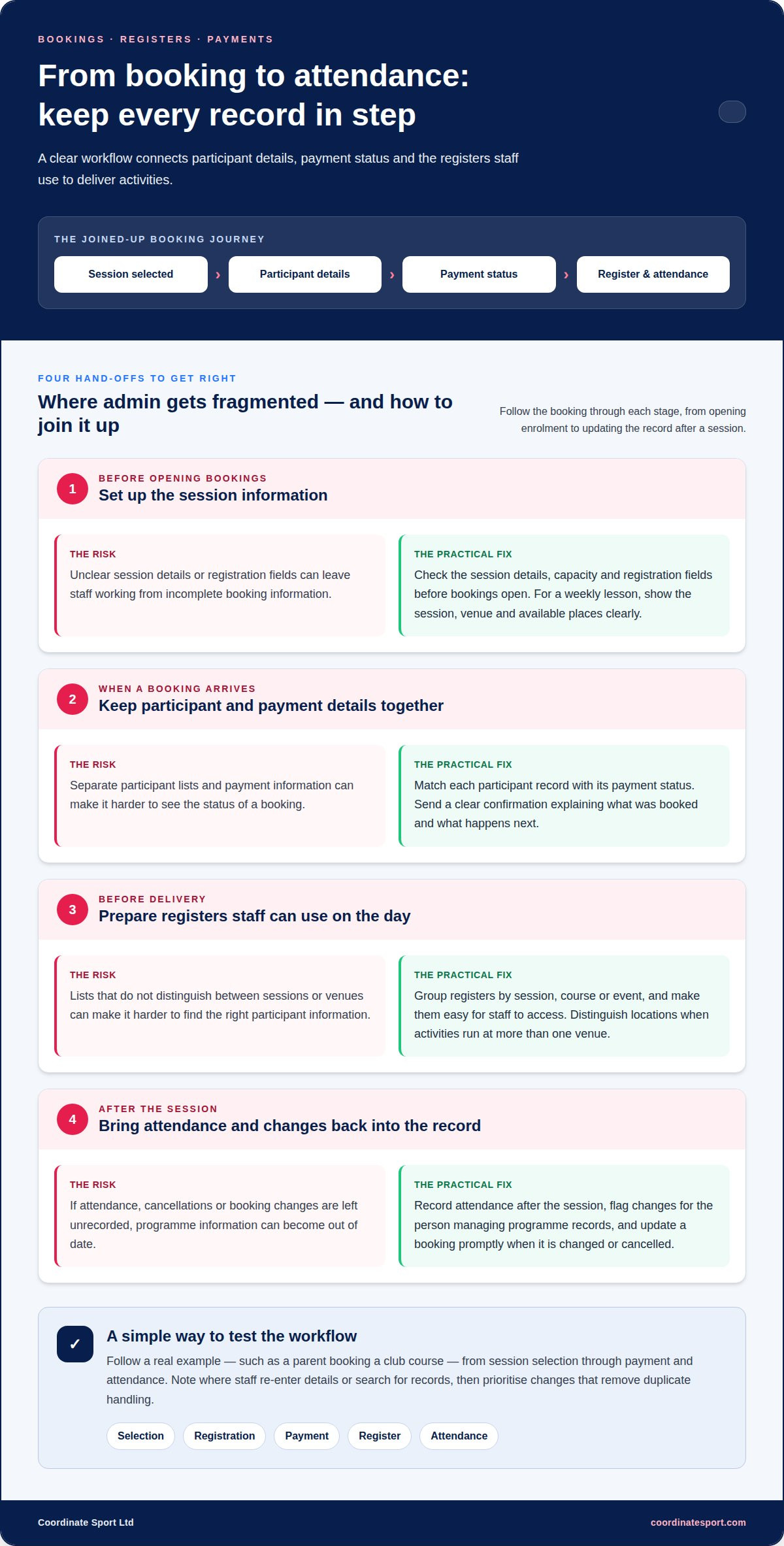
- Before opening bookings: check session details, capacity and registration fields.
- When a booking arrives: match the participant record with its payment status.
- Before delivery: prepare an accurate register for each activity.
- After the session: record attendance and resolve outstanding updates.
Review the process using a real example, such as a parent booking a club course. Follow each step from selection through payment and attendance. Note where staff re-enter details or search for records. Then prioritise changes that remove duplicate handling. A well-structured online booking and payment process can connect registration with the records teams use to deliver sessions.
Keep organisational details alongside the booking workflow so families and staff can identify the operator responsible for records and payments. Coordinate Sport Ltd is registered in the United Kingdom under company number 16543333, according to Companies House. Its registered office is Building 5 Carrwood Park, Selby Road, Leeds, United Kingdom, LS15 4LG. Keeping this information accessible can support clear communication when a family needs help with a registration, payment status or attendance record, while the booking record remains the working source for session updates.
Community and participant retention
Retention depends on the experience between sessions. For a tennis club, that includes clear updates, familiar staff and easy access to programme details. Map a participant’s journey from first enquiry to their next booking, noting where communication stops or families need to repeat information. A consistent record helps staff understand previous activities and respond usefully. It also gives managers a clearer view of returning participants.
Use attendance patterns to guide timely follow-up. If a regular participant misses a session, check the record and send a helpful message. For a children’s holiday programme, a parent may need dates, venue details or information about another activity. Keep messages relevant to the participant’s interests and previous bookings rather than sending every family the same general update. Useful communication makes it easier for people to stay connected.
Retention also depends on listening. Invite participants or parents to share feedback after a course, then record recurring themes. If families mention confusing arrival instructions, improve the next confirmation. If a club member asks about another activity, make that option easy to find. A reported claim puts acquiring a new coaching client at 5-7 times the cost of retaining an existing one. Another claim says a 5% improvement in customer retention can increase profits by 25-95%. Treat these as prompts to measure your own returners and follow-up, not as guaranteed results.
- Track return visits: compare attendance records across successive programme periods.
- Act on feedback: assign each issue to a staff member and record the response.
- Personalise updates: use previous activity interests to make messages relevant.
- Review drop-offs: identify where participants stop attending or booking.
Set a regular review point, such as when each course ends. Compare registrations with attendance and repeat bookings, then choose one improvement for the next programme, such as clearer joining information or a follow-up message. Customer and participant account management can help staff organise interaction history. This gives teams a practical basis for recognising returning participants and building stronger relationships across sessions, clubs and events.
Staff scheduling and cover management
Start each rota with the activity plan. For a football club, list every session, venue, start time and assigned role. Match available staff to those requirements before publishing the schedule. Keep the latest version accessible to managers and team members, giving everyone a shared view of their commitments and helping identify uncovered sessions early.
Set a clear process for changes. If a staff member reports an absence, identify the affected activity first. Then review who is available and suitable for the role. Record the replacement and notify the people responsible for delivery. A holiday programme coordinator, for example, can review each venue’s schedule before confirming cover. Visible updates help prevent outdated rota details from circulating across the team.
Set expectations before the programme begins. Explain how staff should report availability changes, where they’ll find rota updates and who approves replacements. Keep contact details and role assignments together so managers can act quickly when plans shift. A recurring swimming course, for instance, may need separate cover arrangements for poolside support and reception. Clear responsibilities make handovers easier to manage.
- Plan: map each session, location, time and staffing role.
- Assign: match available team members to scheduled activities.
- Update: record absence changes and tell affected colleagues.
- Review: check upcoming sessions for gaps before delivery.
Use a consistent record to review staffing patterns after each programme. Compare planned cover with changes made, then identify where scheduling caused pressure. If a venue repeatedly needs last-minute adjustments, review the activity timetable and staff availability together. Reporting and data can help management teams identify operational patterns and plan future programmes with greater oversight.
For a more coordinated approach, explore staff scheduling and cover management for sport and activity programmes.
Professional development opportunities may also be relevant when reviewing staffing plans. CAA Ignite was scheduled for 16th October 2026 at Sky Studios in Isleworth, London. Managers can keep such dates visible alongside programme planning and consider whether attendance affects availability, then make any needed adjustments through the usual cover process. Connecting these checks with rota reviews can help teams spot potential clashes early and preserve clear responsibility for delivery.
Coordinate Sport: Sports CRM and booking software
Coordinate Sport brings booking and activity administration together for sports and activity providers. Coordinate Sport CRM & Booking Software supports online registration for sessions, courses, clubs, camps, holiday activity programmes and events. Providers can also manage online payments and participant accounts, while branded booking sites give customers a way to find and book activities.
For closer oversight of staff cover and programme coordination, the Sports Activity Provider Staffing Application and Activity Management Application support these operational needs. They can help organisations managing different types of activity or teams replacing disconnected booking and administration processes with a joined-up approach.
Use your current workflow to decide where to start. Identify whether bookings, participant records or staffing coordination creates the most friction, then explore the relevant tools. Visit coordinatesport.com to learn more about the software.
Build your next stage of coordination
Choose one operational priority for your next programme cycle. You might want to give managers a clearer view of staffing, make registration easier to oversee or improve how teams use participant information. Define what a smoother process would look like for your organisation, then use that goal to guide your software decision. A focused starting point helps you assess what your team needs while keeping wider plans to coordinate sport delivery in view.
Coordinate Sport offers Coordinate Sport CRM & Booking Software, a Sports Activity Provider Staffing Application and an Activity Management Application. Consider how these tools could fit your workflows, whether you’re reviewing bookings, staff cover or activity administration. Take the next step by exploring Coordinate Sport’s applications and identifying the processes your organisation wants to improve.
Contact Coordinate Sport to discuss your operational priorities and take the next step with confidence.