
Disconnected admin is a coordination problem, not a limit on what a club can do. Sports participant management software brings participant records and everyday activity administration together, helping teams organise registrations, payments, schedules and communications. The goal is clearer oversight, not more software for its own sake.
When registrations sit in one system, attendance in a spreadsheet and session updates in messages, keeping everyone aligned takes extra work. A joined-up system gives organisers and activity providers a clearer view of who is booked, what is happening and what needs attention.
This guide explains what sports management software does and how communication, calendars, attendance tracking and staffing tools can support clubs and activity programmes. You’ll see which functions simplify everyday administration, how platforms differ and how to assess what fits your organisation. The right choice matches how you deliver activities, not simply the one with the longest feature list.
Key Takeaways
- Understand how a single system can bring core club administration, registrations and payment collection together.
- Learn how to organise team updates and reminders so participants receive relevant information.
- Use calendars and attendance records to improve visibility of sessions, events and participant presence.
- Compare provider capabilities against your club’s activities and coordination needs to find a practical fit.
1. What Is A Sports Management Software?
Sports management software brings club administration into one working system. Sports participant management software can organise member records, registrations, schedules and payments, rather than leaving each task in a separate spreadsheet. For example, an administrator can check who registered for a session, then review attendance and membership information alongside team records. This gives coaches and organisers a clearer operational picture.
What should this type of software include? Look for online registration, customer accounts, payment processing, scheduling, attendance records and communication tools. These functions help clubs coordinate activities and make information accessible to the people who need it. Reporting can also bring financial and participation information together, helping management teams review activity without rebuilding the picture from separate records.
Membership subscriptions need a clear route from sign-up to payment. A system can collect fees online or in person, either in full or over time, and connect each transaction to a participant’s account. For example, an administrator can match a payment to the relevant membership record, then review collected fees in a financial report. Clear records make it easier to identify incomplete registrations and follow up through the club’s usual process.
Availability matters when coaches plan sessions or matches. Member records can help organisers see who is available, while calendars keep events and workouts accessible with up-to-date information. A mobile app can support use from the field to the front desk, giving coaches, members and parents practical access to relevant team information. Grouped members and reminders can also support communication and engagement around activities.
What are the risks and limitations of sports participant management software? Inaccurate or outdated records can undermine schedules, payment tracking and reports, so clubs need a consistent update process. Before selecting a system, map how sports participant management software would support registration, availability and reporting in your club. A platform can only help with the tasks its features cover, so organisers should identify essential workflows and responsibilities before changing their processes.
2. Team communications and notifications
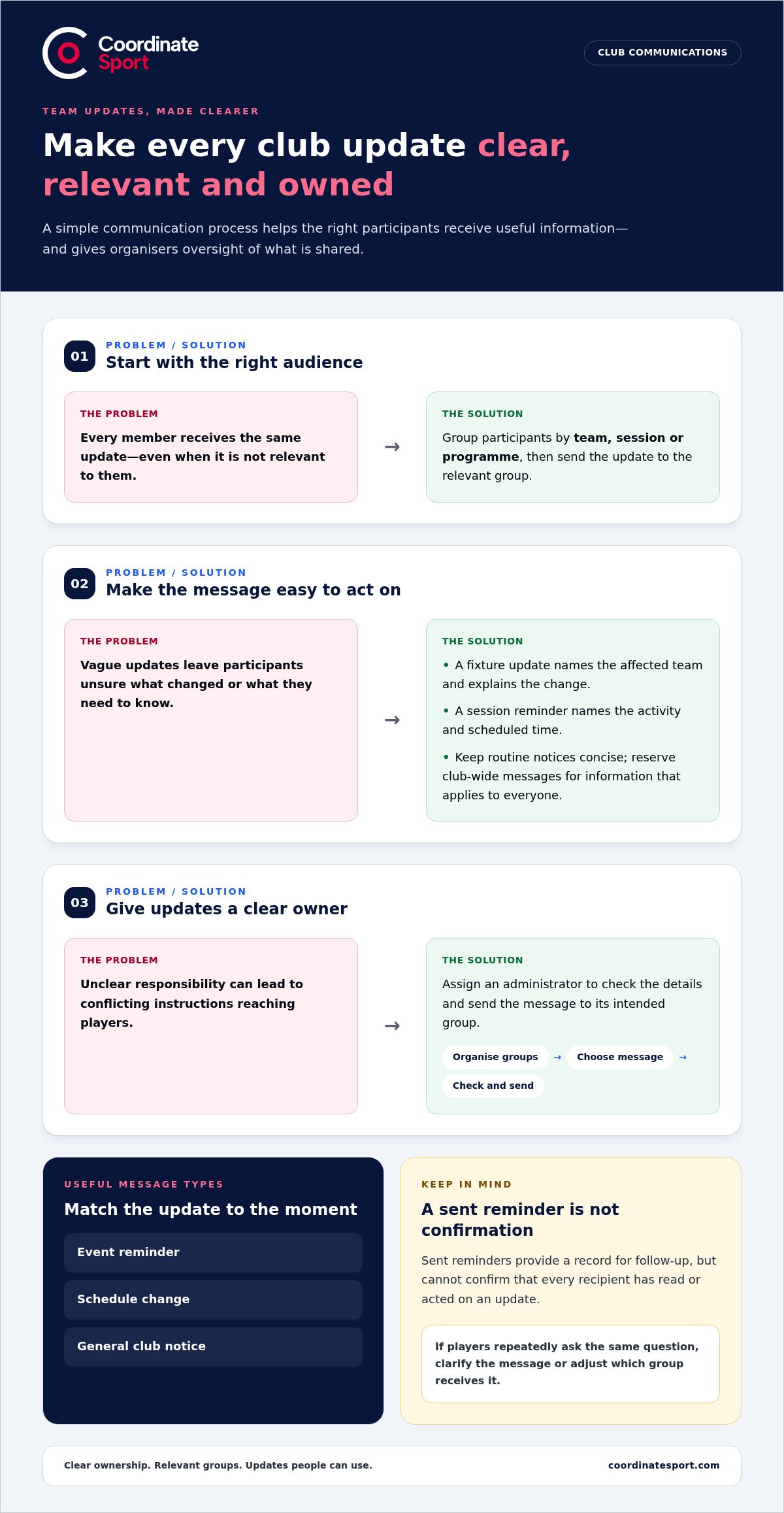
Clear communication helps participants and organisers act on the same information. Sports participant management software can group participants and send messages, including activity reminders. For example, a reminder about a training session can go to the relevant group rather than every member receiving an unrelated update. Focused messages give administrators a consistent way to share routine information with the right people.
Does this software integrate with accounting and communication tools? Features vary: some systems include communication tools, while accounting connections depend on the platform. Assess how payment records and reports can be reviewed, and whether messages use current participant details. This helps club management reduce duplicate entry and keep financial and member records aligned.
Set a simple communication process before sending updates. First, organise players into useful groups, such as a team, session or programme. Then choose the message type: an event reminder, a schedule change or a general club notice. Finally, assign an administrator to check the details and send them to the intended group. Clear ownership helps prevent conflicting instructions reaching players.
Make the next action obvious in every message. A fixture update should identify the affected team and explain what has changed; a session reminder should name the activity and scheduled time. Keep routine notices concise, and reserve club-wide messages for information that applies to everyone. Coaches can focus updates on their participants, while administrators retain oversight of broader announcements.
Communication insights can help organisers review engagement. If players repeatedly ask the same question, clarify the message or adjust which group receives it. Sent reminders provide a record for follow-up, but cannot confirm that every recipient has read or acted on an update. The value of sports participant management software is in connecting communication with the activities it supports. Explore club communication and booking workflows to consider how those processes can work together.
3. Club calendars and attendance tracking
A shared calendar gives a sports club one place to organise games, events and sessions. Sports participant management software can help organisers record the activity, time and team, then update schedules when plans change. Coaches and participants can refer to current information, while administrators avoid coordinating from separate versions. Updating a fixture’s calendar entry keeps revised details together.
Can these systems manage attendance, teams and fixtures? Yes, sports participant management software can support team organisation, activity scheduling and attendance records. Organisers can record who attended and link the entry to the relevant team or activity. This makes it easier to review participation and follow up on missing information.
Youth clubs can include guardian steps in registration and communication. For example, a parent or guardian can register a young participant and receive information relevant to their group. Before an activity, share schedule changes through the club’s communication tools. A clear process helps families plan and gives coaches the information they need to run the session.
Mobile access can make schedules and updates available beyond the clubhouse. A coach might check a fixture before travelling, while a parent views a session change on a phone. Messages can remind participants about upcoming activities. They work best when calendars and participant groups stay current, rather than replacing those essential updates.
Public-facing tools create another route into club activities. A club website can explain its programmes and direct families towards registration, while a booking portal can display available sessions. Some organisations also use webshops for club kit; keeping purchases distinct from activity bookings helps members understand each process. Map the journey from finding an activity to registration, reminders and attendance. This helps administrators see where sports participant management software can support members and club operations.
4. Sports management software providers
To choose sports participant management software for a UK sports club, start with its daily workflow. Map how a participant moves from finding an activity to registration, payment, reminders and attendance. Then prioritise a system that supports those steps without creating duplicate records. A junior club and a multi-activity organisation may need different workflows, so fit matters more than a long feature list.
Next, assess the system’s operational coverage. Can administrators organise participants by club, team, course or session? Can it collect online payments and connect them to the relevant registration? If staff need to coordinate coaches as well as participant information, include that requirement in your assessment. A clear requirements list helps show whether one platform can support the club’s core processes.
Test the reporting process before choosing. For example, follow a sample registration through payment recording and into a participant summary. Check whether reports give management teams useful information about participation, income and activity delivery. Find out how staff can correct an entry and whether the updated information appears where administrators need it. Reports support decisions only when their underlying records are accurate and easy to maintain.
Review communications and schedules as part of the same exercise. Create a sample session, assign a team and see how organisers would share a schedule change or send a reminder. Consider who needs access: administrators may manage registrations, while coaches need practical session details. The system should make responsibilities clear, rather than leaving staff to reconcile separate documents.
Finally, consider the organisation’s next stage of delivery. A club adding holiday programmes or new courses may need registration and reporting workflows that cover those activities too. Write down essential tasks, compare them against the system’s demonstrated workflow, and prioritise the gaps that currently consume staff time. To put these needs into practice, explore a coordinated sports management system for bookings, participant records and activity operations.
Coordinate Sport: Sports CRM and booking software
Coordinate Sport provides sports CRM and booking software for organisations that need tighter control of participant administration. Use it when registrations, bookings and activity coordination are difficult to manage across separate processes.
Online booking and registration covers sessions, courses, clubs, camps, holiday activity programmes and events. The Activity Management Application supports activity organisation, while the Sports Activity Provider Staffing Application helps coordinate coaching staff and session assignments. Together, these tools support participant administration and activity delivery.
If your club or activity organisation is ready to streamline these workflows, contact Coordinate Sport or visit coordinatesport.com.
Make coordination part of your retention strategy
Make your next step operational: identify where participants experience friction, then decide who owns each improvement. A confusing sign-up journey, unclear activity updates or inconsistent records can make participation harder to sustain. Set a clear process for staff and review it as your programme changes. Better coordination starts with deliberate choices, not simply adding more tools.
Sports participant management software can support your organisation when it fits the way you run activities. Coordinate Sport offers Sports CRM and booking software, an Activity Management Application and a Sports Activity Provider Staffing Application. These tools help bring participant administration, activity delivery and staffing workflows under clearer oversight.
Discuss the processes you want to improve and the activities you need to manage. Contact Coordinate Sport to discuss your needs, then take the next step towards a more organised experience for your members.
Frequently Asked Questions
What Is A Sports Management Software?
Sports management software is a digital system for organising the administration behind a club or activity programme. It can help staff manage registrations, participant accounts, schedules and records in a structured way. For example, an administrator can identify which participants belong to a programme and share the relevant information with coaches and management.
Can I schedule training sessions for specific teams?
Yes. A club can organise sessions by team and keep the schedule aligned with each group’s activities. For example, administrators might create separate entries for a junior squad’s training and a senior team’s fixture. Clear team labels help coaches and participants identify the right event, while a shared calendar gives organisers one place to update details when plans change.
Can I track player attendance in training sessions?
Yes. Digital registers can record which participants attended a particular session. Coaches or administrators can update attendance after training, then review entries when planning future activities. Checking attendance against registered participants can help staff identify records that need follow-up and maintain a useful history for club management.
What does it cost?
Software costs depend on the plan and payment-processing structure. Compare the subscription with transaction charges, then consider the staff access and functions your organisation needs. A small club may prioritise straightforward bookings, while a larger provider may need more reporting or staffing tools. Assess the full operating cost against your club’s actual workflow before choosing a system.
What is the best sports participant management software in the UK?
The best option is the one that fits your club’s activities and administration, not necessarily the one with the most features. Check whether it supports the work that matters to your organisation, such as managing different programmes, coordinating staff and producing useful reports. Coordinate Sport offers three plans, Essential, Advanced and Pro, with different pricing, staff limits and features. Compare them against your operational priorities.
How much does sports participant management software cost in the UK?
The total cost varies according to the plan and how your organisation processes bookings and payments. Build your comparison around the functions you’ll use, the staff who need access and the transaction charges that apply. For a fair assessment, compare ongoing costs with the administrative tasks the system will support, rather than looking at the subscription alone.