Growth costs more than adding another session. To scale a sports activity business, budget for the additional staffing, venues, equipment, insurance, marketing and administration that increased demand can bring. The total depends on your programme and delivery model, so map each cost against the income and capacity it supports.
Attracting more participants is only one part of growth. More bookings also mean more payment administration, staff coordination and customer queries, alongside opportunities to build relationships with schools, nurseries and parents.
This guide outlines the main costs to plan for and how to decide where to invest first. It also covers how software, partnerships and venues can support sustainable growth, helping you strengthen the operation while staying in control of day-to-day delivery.
Key Takeaways
- Build a growth budget around the people, places and operational capacity each new programme needs, then prioritise costs that support sustainable delivery.
- Strengthen local relationships with schools, nurseries and parents by making communication, safeguarding and session organisation part of your growth plan.
- Recruit coaches with the skills your programmes need, and create a consistent approach to onboarding, training and day-to-day support.
- Explore suitable funding routes and use booking and activity management tools to keep registrations, staffing and programme administration organised as demand grows.
Building relationships with schools, nurseries and parents
Local partnerships can turn a successful session into a steady source of new participants. Start with a school or nursery and learn its priorities before proposing activities. A school may value lunchtime movement sessions, while a nursery may need age-appropriate activities within its programme. Match your offer to the setting, available space and children’s needs.
Make your first approach practical. Prepare a one-page brief covering session aims, age groups, delivery arrangements and the information each party needs. A meeting agenda can focus discussion on dates, access, staff responsibilities and how families will hear about sessions. Record agreed actions and follow up with a clear summary.
Use simple tools to keep communication consistent:
- Partnership brief: explain the activity, intended participants and proposed delivery in one concise document.
- Shared session calendar: coordinate dates, venue access and school events with the relevant contact.
- Parent feedback form: gather views on registration, communication and the session experience after a programme.
Give parents the practical details before registration. Explain where sessions take place, what children should bring, how to report an absence and whom to contact with questions. A welcome email, for example, can include the venue entrance, arrival arrangements and a summary of the session plan. Consistent updates help families know what to expect.
Safeguarding also shapes trust. The Care Act 2014 put adult safeguarding in England on a statutory footing, according to UK Government. Agree how your organisation and each setting will share relevant concerns, and make reporting routes clear to staff and families. Keep communications factual, confidential and directed to the appropriate person.
Review each relationship when a programme ends. Ask the school contact and parents what worked, then use their feedback to adjust timings, booking information or session communications. Strong partnerships grow from reliable delivery and clear follow-through, not just an introduction.
What UK legal requirements apply when expanding a sports activity business?
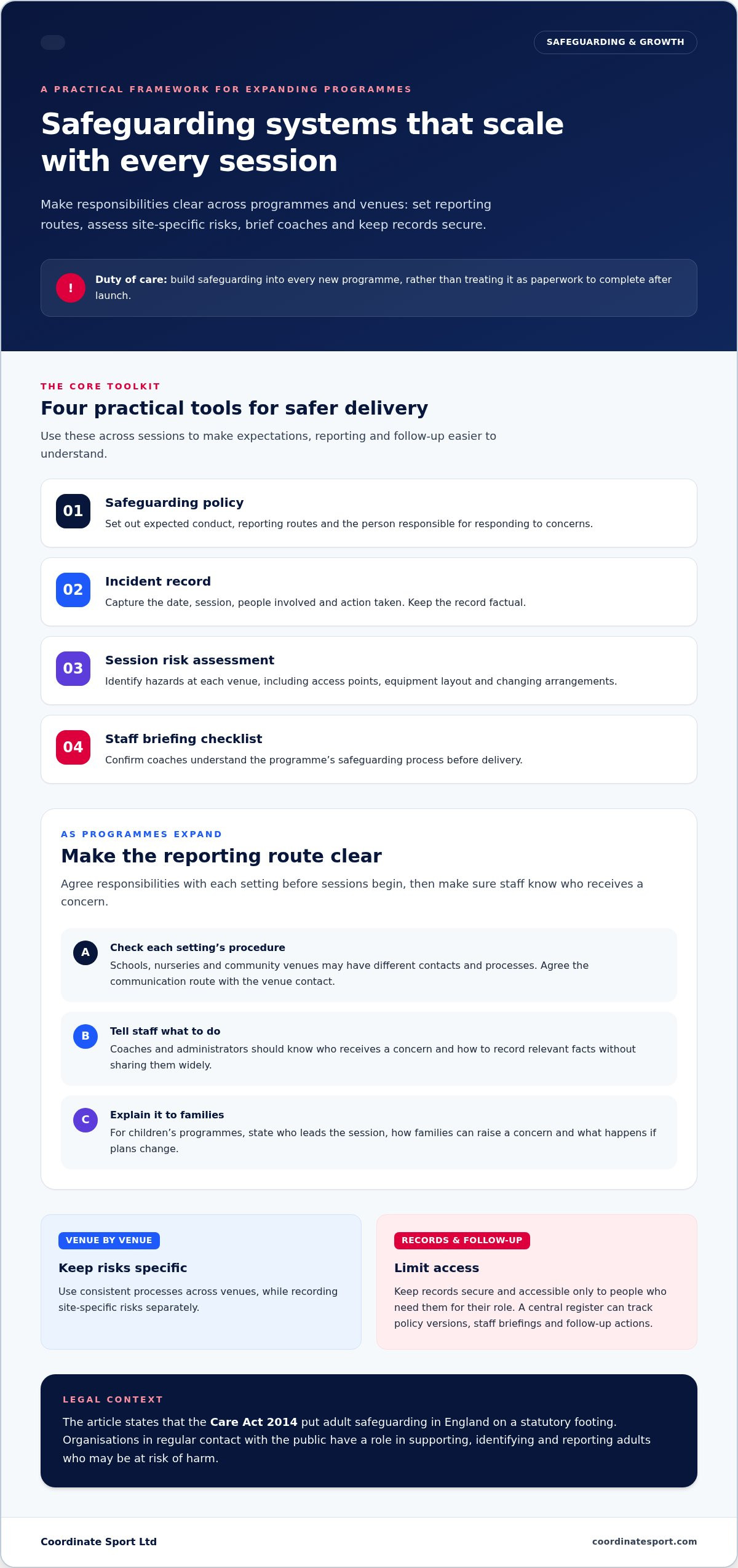
Growth can change who attends, where sessions run and which staff support them. Sports and activity organisations have a duty of care that includes safeguarding children and people in vulnerable situations. Build safeguarding into every new programme rather than treating it as paperwork to complete after launch.
Organisations in regular contact with the public have a role in supporting, identifying and reporting adults who may be at risk of harm. Make the reporting route clear to coaches, administrators and venue contacts. Coaches should know who receives a concern and how to record relevant facts without sharing them widely.
Use practical tools to make responsibilities visible across sessions:
- Safeguarding policy: set out expected conduct, reporting routes and the person responsible for responding to concerns.
- Incident record: capture the date, session, people involved and action taken, using factual language.
- Session risk assessment: identify hazards at each venue, such as access points, equipment layout or changing arrangements.
- Staff briefing checklist: confirm that coaches understand the programme’s safeguarding process before delivery.
As you expand, review how each setting handles concerns. Schools, nurseries and community venues may have different contacts and procedures. Agree the communication route before sessions begin, then make sure staff know which organisation receives a report. Keep records secure and limit access to people who need them for their role.
For children’s programmes, explain expectations to parents and participants clearly. State who leads the session, how families can raise a concern and what happens if plans change. Use consistent processes across venues, while recording site-specific risks separately. A central register can track policy versions, staff briefings and follow-up actions as programmes grow.
Before adding a venue or programme, review its safeguarding arrangements with relevant staff and the venue contact. This turns a broad duty of care into clear responsibilities for each session.
Build safeguarding into each programme, set clear conduct and reporting routes, and ensure staff know how to report and record concerns. Assess venue-specific risks, agree procedures with venue contacts, keep records secure and brief coaches before delivery.
How can a sports activity business recruit and train coaches as it grows?
Recruit for the sessions you plan to deliver, not a vague need for extra hands. Write a role profile covering the sport, participant age groups, session duties and required communication skills. A school-based multi-sport programme, for example, may need coaches who can adapt activities for different abilities and explain instructions clearly. A role scorecard helps you assess applicants against consistent criteria.
Use a structured interview guide to explore how candidates would handle real coaching situations. Ask how they would adapt a drill if children lost interest or respond to a late venue change. Include a practical assessment, such as demonstrating an activity and explaining its purpose. Record evidence against the role scorecard so decisions reflect relevant skills, not interview confidence alone.
Make onboarding consistent with a checklist that covers:
- Programme delivery: session plans, equipment routines and the process for reporting changes.
- Participant experience: clear instructions, inclusive activity options and professional communication with families.
- Team coordination: who leads each session, how cover is arranged and where updates are recorded.
- Safeguarding procedures: the organisation’s reporting route and the named person who receives concerns.
Training should continue after induction. Pair a new coach with an experienced colleague for observation, then use a coaching observation form to record strengths and development points. Review how the coach explains a warm-up, manages transitions and adapts an activity when participation changes. Agree one practical improvement for the next session and revisit it.
As programmes expand, a shared rota can match coaches to venues, activities and availability. A staff scheduling application helps organise shifts and reveal gaps, while a training log can track onboarding and development. Review both before publishing each programme timetable. This creates a repeatable way to recruit, prepare and support coaches, with clear delivery expectations across locations.
What funding and grants are available to grow a UK sports activity business?
Different funding routes suit different growth costs. A grant may support a defined community project, while retained income can fund equipment or staff development. Loans involve repayments, so compare projected income with those commitments before borrowing. Sponsorship may support a specific programme when a business sees value in reaching its participants.
Start with a project budget. List the expansion’s purpose, expected costs, delivery dates and intended outcomes. For example, a new holiday programme budget could separate venue hire, equipment, coach recruitment and promotion. A cash-flow forecast shows when those costs arise and when fees or funding may arrive. Keep it realistic and update it as bookings change.
Charitable funding can be modest and purpose-specific. Its 2025 funding applications closed on 23 February 2025, so treat that round as historical, not current. Check each fund’s eligibility, purpose, application window and reporting expectations before preparing a proposal.
Use a grant tracker to record funders, closing dates, eligibility criteria, required documents and application status. A spreadsheet can help compare opportunities, while a shared calendar helps protect submission deadlines. Keep supporting documents together, including budgets, delivery plans and evidence of community need. Tailor each application to the fund’s priorities instead of reusing a generic pitch.
Before committing to finance, test how the expansion performs at different booking levels. Estimate income from confirmed registrations separately from hoped-for demand, then identify which costs can be delayed if uptake is slower. This helps you decide whether to stage the launch, seek a grant for a specific cost or use trading income.
Bring budgets and expected registrations together in one operating plan, then compare actual results with forecasts after each programme. This gives you a clearer basis for future funding applications and growth decisions.
Coordinate Sport: Sports CRM and booking software
Coordinate Sport Ltd brings booking, participant administration and activity management into one platform for sports activity providers. Its Sports CRM and booking software supports online booking and registration for sessions, courses, clubs, camps, holiday activity programmes and events.
As programmes expand, online payments and fee collection, along with customer and participant account management, help organise enrolments and keep participant information together. The Activity Management Application supports activity administration, while the Sports Activity Provider Staffing Application helps manage staffing. Branded customer booking sites give families a direct route to register.
Consider this setup when manual processes make it harder to coordinate bookings, participants and staff. Choose tools that address your current operational needs, then build on them as your activity schedule develops.
Contact Coordinate Sport Ltd to discuss how its software could support your operations.
Make your next growth move with confidence
To scale a sports activity business, start with the pressure point holding back your next step. Is it coordinating staff, managing activity delivery or organising bookings? Choose the operational priority first, then align your processes and tools around it. This keeps growth focused on better delivery, rather than complexity for its own sake.
Coordinate Sport Ltd’s Sports CRM and booking software, Sports Activity Provider Staffing Application and Activity Management Application support different parts of your operation. Consider how each could fit your current workflow and planned programmes. A clear discussion about your requirements can help you assess whether the platform suits the way your organisation operates.
Contact Coordinate Sport Ltd to discuss your growth plans and take a practical next step towards a more organised operation. Build deliberately, keep your priorities clear and give your business room to grow.
Frequently Asked Questions
What are the costs involved?
Plan for costs that increase as delivery expands, including coach recruitment and training, venue access, equipment, insurance, promotion and administration. Separate one-off purchases, such as equipment, from recurring commitments, such as staffing and venue hire. Compare each cost with expected income and capacity. A new venue, for example, brings hire costs, so consider its schedule and likely enrolments when assessing its value.
What are the best ways to scale a sports activity business in the UK?
Grow in stages, testing demand and operational readiness before adding a programme or location. Set a clear measure for each pilot, such as repeat registrations, participant feedback or coach availability. Review the results before committing more resources. A provider running term-time sessions, for example, could trial a holiday programme with a defined timetable, then use attendance and enquiries to guide the next decision.
How much does it cost to expand a sports coaching or activity business?
There is no single expansion cost. The budget depends on the format, venue, staffing model and equipment required. Estimate each item for the specific programme, including preparation and ongoing delivery. A pop-up session using an existing venue has different costs from a new site requiring equipment and additional staff. Forecast when costs fall due and when participant income is expected.
How can a sports activity business attract and retain more customers?
Make it easy for families to understand your offer, register and return. Use a clear programme description, straightforward booking steps and timely updates about session arrangements. After a course, invite participants to explore a suitable next activity and ask for feedback. A reminder about upcoming enrolment can help an interested family continue, while feedback can reveal friction in communication or registration.
How can sports activity businesses scale through franchising, licensing or new locations?
Choose an expansion model that supports consistent delivery. A new location gives you direct oversight, while franchising or licensing requires clear procedures and defined responsibilities. Before expanding, document session standards, staff training, customer communications and reporting. Pilot the model in one setting, assess how well routines transfer, then refine the framework before widening its reach.
How can technology and booking software help scale sports activities?
Booking software can reduce manual coordination by bringing key programme tasks into one workflow. Coordinate Sport Ltd’s platform includes scheduling, digital registers, waiting lists and messaging to help teams organise session information and communicate with participants. A waiting list, for example, helps manage interest when a course is full, while digital registers provide a session record. Similarly, functional fitness facilities often turn to specialist software such as VO2WOD for performance tracking and member management. Choose tools that address the operational bottleneck you need to resolve.