
What happens when a staff change at one venue leaves another session short? If you manage staff across activity locations using separate spreadsheets, messages and calendars, gaps can be hard to spot before they disrupt the day. A small change at one site can affect coverage and communication elsewhere.
The answer isn’t to oversee every location in exactly the same way. Instead, create a shared process for planning and communicating staffing information, while keeping each activity’s needs in view. When assignments and changes are visible to the right people, managers can make decisions with greater confidence and less last-minute confusion.
This guide sets out practical steps to map roles and coverage, establish a repeatable scheduling and communication process, and respond when plans change. It also explains how sports staffing software can help connect staff, sessions and locations as your programme develops.
Key Takeaways
- To manage staff across activity locations, match planned sessions and site requirements with available staff capacity.
- Set shared assignment conventions and communication expectations, while allowing each location to account for its delivery needs.
- Review coverage regularly to find unresolved staffing changes and decide which sessions need attention.
- Use a repeatable process for planning, publishing assignments and reviewing delivery, so changes are easier to manage.
- A staffing application designed for sports activity providers can bring scheduling, session assignments, workforce tracking and deployment into one operating system.
Manage staff across activity locations by fixing the visibility gap
Effective cross-location staffing management gives managers a clear view of who is assigned where, what coverage each activity needs and which changes require action. It connects people, session assignments and operational information across delivery sites, rather than treating each timetable as a separate plan. The aim is a reliable overview that supports sound decisions while leaving day-to-day delivery with the people responsible at each location.
To manage staff across activity locations, you need to see how assignments connect. A coach scheduled for a club session may also be part of the staffing plan for a course at another venue. If those commitments sit in separate records, an overlap can be hard to spot. It may also be unclear whether a session has suitable cover or who needs to know when plans change.
Where multi-location staffing becomes difficult
Disconnected schedules and communication channels can mean an update reaches one location but not the others affected. For example, a late absence at a sports session might prompt a manager to reassign someone from a course. If the course lead is working from outdated information, they may still expect that person to attend. Both sessions now need attention, and the manager has to piece together the latest plan before either team can act.
Coordination can become more demanding across clubs and holiday activity programmes, where plans and staffing needs vary by site. Keep assignment details and changes visible to the people who need them. The broader principles of Staff management include coordinating and supporting people. Multi-site delivery adds the practical task of connecting those responsibilities with session and location information.
What good cross-location oversight should show
Useful oversight lets a manager quickly answer three questions: which staff are assigned to each session, where is cover unresolved, and which other activities could be affected by a proposed change? This doesn’t mean a central manager must direct every shift. A location lead can manage delivery on the ground, as long as the wider staffing picture remains clear.
Keep shared information focused on operational decisions. For each assignment, make it easy to identify:
- The activity and location, so teams know which session the assignment supports.
- The assigned staff and coverage status, so gaps and changes are visible.
- The person responsible for follow-up, so each unresolved issue has a clear owner.
This shared view helps managers distinguish a local adjustment from a change with wider consequences. A replacement at one venue may affect another session, while a change with no knock-on effect can stay with the local lead. Clear ownership reduces duplicate checking and lets each site deliver its programme without losing sight of the wider operation.
Create a repeatable workflow to schedule staff across activity locations
Build the schedule around delivery needs, not just a list of available people. Start with the sessions planned at each location, match suitable staff to each assignment, then make the current plan easy to find. A consistent process gives managers a dependable planning rhythm and makes it clear who owns decisions when capacity or requirements change.
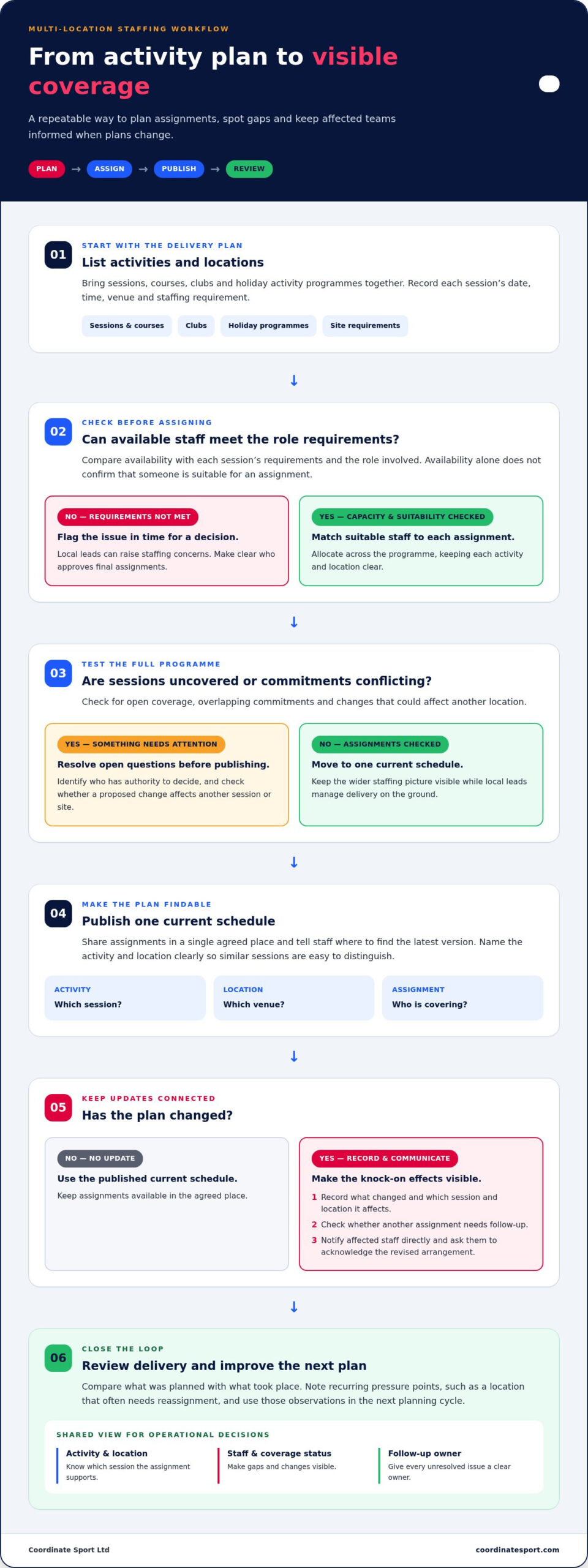
List planned sessions and location needs, check staff capacity and suitability, assign responsibility, publish the schedule, record and communicate changes, then review delivery.
Plan staffing needs before assigning people
Bring the activity plan together first. Include sessions, courses, clubs and holiday activity programmes, plus their locations and any delivery requirements that affect staffing. Set a cut-off for gathering availability and name the person who approves final assignments. Local leads can then flag issues in time, and everyone knows who makes the final decision instead of working from conflicting versions of the schedule.
- List activities and locations. Start with the planned delivery schedule and note each session’s date, time, venue and staffing requirement. This gives you the full set of assignments before you allocate staff.
- Check capacity and suitability. Compare staff availability with each session’s requirements and the role involved. Availability alone doesn’t show whether someone is suitable for a particular assignment.
- Make and check assignments. Allocate staff across the programme, then look for uncovered sessions, conflicting commitments and changes that could affect another location. Decide who has authority to resolve any open questions.
- Publish one current schedule. Share assignments in a single agreed place and tell staff where to find the latest version. Name the activity and location clearly, so people can tell similar sessions apart without relying on separate messages for essential details.
- Review delivery and learn. Compare the plan with what took place. Note recurring pressure points, such as a location that often needs reassignment, and use those observations to improve the next planning cycle.
Publish assignments and keep changes visible
Publishing the schedule isn’t the end of the process. Set a clear rule for changes: whoever makes or approves an update records what changed, which session and location it affects, and whether another assignment needs follow-up. They then notify affected staff directly and ask them to acknowledge the revised arrangement. This closes the gap between changing a schedule and making sure people know what to do.
Distinguish confirmed changes from unresolved issues. A confirmed swap can be recorded and shared. If a change leaves a session without an agreed staff member, keep it visible for follow-up. Coordinate Sport’s staffing coordination application supports scheduling and session assignments for sports activity providers, helping them organise this workflow.
Balance shared staffing standards with each location’s needs
Consistency helps managers compare staffing plans across sites, but uniformity for its own sake can lead to poor assignments. A weekday club, a weekend course and a holiday activity programme may have different timings, delivery demands and staff capacity. To manage staff across activity locations effectively, use a common framework for recording and communicating assignments, then apply it to the needs of each activity.
Standardise the information and decision-making rules that make coordination possible. Adapt deployment choices to local conditions. This gives central managers a dependable view without assuming every venue runs the same programme or has the same staff capacity.
Standardise the information every location needs
Use a shared format so everyone can interpret assignments consistently. Agree how locations, activities and roles are named, where updates are recorded, and what a handover must include. Keep the process practical. The aim is to make information easy to use at a glance, not to add administration that slows local decisions.
At a minimum, align on the details that help staff and managers understand an assignment: activity, location, timing, role, assigned person and current status. Use the same terms across sites. If one team marks an assignment “pending” while another uses “unconfirmed”, it becomes harder to compare coverage and identify what needs attention.
Agree how updates are communicated too. Decide who records a change, who tells affected staff and how the next person taking responsibility receives the latest information. A concise handover should capture the change and any outstanding action, rather than relying on informal messages that may not reach everyone involved.
Allow sensible flexibility in local deployment
Local managers need room to respond to the realities of delivery, within agreed role expectations and communication routes. Session timing, activity type, staff availability and capacity at each location can all shape an appropriate assignment. A shared framework should guide local decisions, not impose identical staffing patterns on programmes with different needs.
For example, a course scheduled across consecutive sessions may benefit from continuity, while a one-off club activity might allow a different suitable staff member to cover. The right choice depends on the session’s demands and available capacity, not on making every location’s rota look alike. Set the principle centrally, then let local leads apply it responsibly.
- Keep local: routine deployment adjustments that stay within agreed role expectations and don’t affect another location.
- Share centrally: changes that affect another session, create a coverage concern or require a decision beyond the local lead’s remit.
This distinction gives teams autonomy without creating blind spots. Local leads can act on operational details, while central coordinators stay informed about changes with wider consequences. Review the shared standards as programmes evolve. Recurring local exceptions can show where the framework needs clarification, rather than signalling a need for a one-size-fits-all rota.
Track staffing coverage and respond to changes before delivery is disrupted
A published schedule is a plan, not proof that every assignment remains covered. Compare planned staffing with confirmed assignments, then highlight open gaps and changes that still need a decision. Knowing who is assigned, which sessions lack confirmed cover and who owns follow-up helps managers act promptly and focus on the locations that need attention.
Keep checks focused on action. A useful review shows upcoming activities by location, confirmed assignments and any absence or change awaiting resolution. This gives managers an operational picture without turning oversight into a judgement of individual staff performance. The purpose is to identify where delivery needs attention, not to create measures that imply more than the information can support.
Choose practical measures for staffing oversight
Track a small set of indicators that connect directly to decisions. Compare planned assignments with confirmed coverage, note unfilled roles and review recent changes that may affect upcoming activities. Grouping this information by location and session helps show whether a gap is isolated or could affect several parts of the programme.
- Planned versus assigned: identify sessions where a staffing requirement has no named assignment.
- Confirmed versus unresolved: separate agreed cover from changes still awaiting a decision or acknowledgement.
- Location and activity: show where each issue sits and which upcoming session it affects.
- Follow-up owner: make clear who is responsible for the next action and whether it has been completed.
Set a review rhythm that fits your programme, with an additional check when a change is reported. Routine checks can bring gaps to light while there’s still time to plan. If an unresolved assignment may leave a session without suitable staff, escalate it directly instead of leaving it on a general to-do list.
Set a response process for absences and schedule changes
Agree who receives absence reports and who coordinates the response. That person should identify the affected sessions, consider suitable reassignment options and check whether moving a staff member would leave another location short. If a decision affects more than one site or falls outside local authority, involve the appropriate central coordinator promptly.
Once a decision is made, update the assignment record and notify the affected staff and location leads. State what changed, which session it concerns and whether any action remains. Give one person ownership of the response so staff don’t receive conflicting instructions or duplicate requests. Close the loop by confirming that the revised plan is understood and related coverage issues have been addressed.
Coordinate Sport’s staffing application supports sports activity providers with scheduling, session assignments and workforce deployment across locations, helping teams track coverage and manage changes.
Bring multi-location staff coordination into one operating system
A shared staffing application is useful when separate schedules, messages and records make an agreed planning process difficult to maintain. It gives your team a consistent way to organise assignments, track the workforce and support staff deployment across activity locations. The application supports the operating process. Managers still assess suitability, set priorities and make decisions based on each session’s needs.
Coordinate Sport provides a staffing application for sports activity providers to coordinate and schedule coaching staff, manage session assignments, track the workforce and support operational deployment across multiple locations. This connects staffing records with the sessions and locations your programme delivers, rather than keeping them apart from day-to-day activity management.
What a purpose-built staffing application can support
Use the application to organise staff assignments across locations and connect workforce information with operational deployment. Managers can review where people are assigned and coordinate staffing decisions across the programme. The value comes from having a shared operational picture and a clear process, not from expecting software to decide who is suitable or resolve every staffing issue automatically.
Before adopting a system, define how your team will use it: who maintains assignments, how updates are recorded and who acts on unresolved coverage. Clear ownership remains essential. Without it, a tool can become another place to check rather than the working record that supports coordination.
Move from disconnected planning to coordinated delivery
Clear assignments, consistent updates and visible coverage help staff and managers work from the same operational plan. Staffing coordination is part of a wider programme: activity management connects workforce information with the activities being delivered, while local teams retain room to respond to their own session needs. This supports oversight without requiring central managers to direct every shift.
Look for practical signs that your current process needs a stronger operating home. Teams may regularly reconcile different schedules, ownership of updates may be unclear, or managers may struggle to see how a change affects other locations. A purpose-designed application can support the coordination behind your programme and give managers a more structured way to organise deployment.
To manage staff across activity locations more consistently, connect your team’s planning rules to a staffing process it can use day to day. Coordinate Sport supports sports activity providers with staffing coordination as part of wider activity management.
Make your next staffing plan easier to run
Choose an upcoming delivery cycle as your starting point. Identify where coordination takes the most effort, then agree one practical improvement your team can put into action. You could make staffing information easier to access, clarify who owns a change or give managers a more consistent view across sites. A focused first step can help turn a useful process into a routine your organisation can sustain.
If you’re looking to manage staff across activity locations with more confidence, consider whether a system designed for sports activity providers could support your team. Coordinate Sport’s staffing application supports scheduling, assignments, workforce tracking and operational deployment across locations, connecting staffing with the wider activity programme.
Explore Coordinate Sport’s staffing application to see how it can support staff coordination across your activity programme.
Frequently Asked Questions
How do you manage staff across multiple activity locations?
To manage staff across activity locations, give each site a clear way to raise staffing needs and name a coordinator who can resolve issues spanning more than one venue. If a staff member is requested by two locations at overlapping times, the coordinator can compare both commitments before confirming a change. Keep local leads involved in decisions affecting their sessions, and review recurring pinch points when planning future activity.
How can sports providers keep staff schedules organised across different locations?
Use consistent labels for venues, activities and roles so schedules are easy to scan, even when teams use different local names in conversation. Separate a staff member’s general availability from confirmed session commitments, and make travel or handover time visible when it affects whether assignments are workable. Back-to-back sessions at different venues, for example, may look possible on paper but leave too little time to travel between them.
What is the best way to handle staff absences across activity locations?
Start by identifying the sessions affected, then appoint one person to coordinate cover rather than letting several managers make competing requests. Check whether a potential replacement is available and suitable for the activity, and consider the effect of moving them from another assignment. Once a decision is made, update the relevant teams through the agreed channel. Keep the original absence and the resulting change distinguishable in the record.
How can managers improve visibility of staff assignments across locations?
Make assignments searchable by staff member as well as by location and session. This lets a manager check someone’s other commitments before proposing a swap, rather than viewing each venue in isolation. Use clear status terms, such as proposed, confirmed or changed, and agree what each means. A review can then distinguish a genuine coverage issue from an assignment that is still being discussed.
Should staffing processes be the same at every activity location?
Use the same core rules for recording assignments, sharing changes and escalating unresolved coverage, but let local deployment reflect the activity. A recurring club session may benefit from continuity, while a one-off event may need a different mix of roles. Local leads can make decisions within agreed boundaries. Changes affecting another site or requiring wider approval should go to the central coordinator.
How can activity providers reduce scheduling conflicts between locations?
Check each proposed assignment against the staff member’s commitments across the full programme, not just the venue making the request. Include session start and finish times, location details and any necessary transition time when reviewing possible clashes. If an assignment changes, review the person’s other scheduled activities before confirming the update. This helps catch conflicts created by a swap, as well as those in the original plan.
Can staffing software help coordinate coaches across multiple locations?
Yes. A staffing application can help sports activity providers coordinate and schedule coaching staff, manage session assignments, track the workforce and support operational deployment across locations. Coordinate Sport’s staffing application is designed for sports activity providers. It supports workforce coordination while managers apply their judgement to local needs, role suitability and the decisions required to deliver each activity.