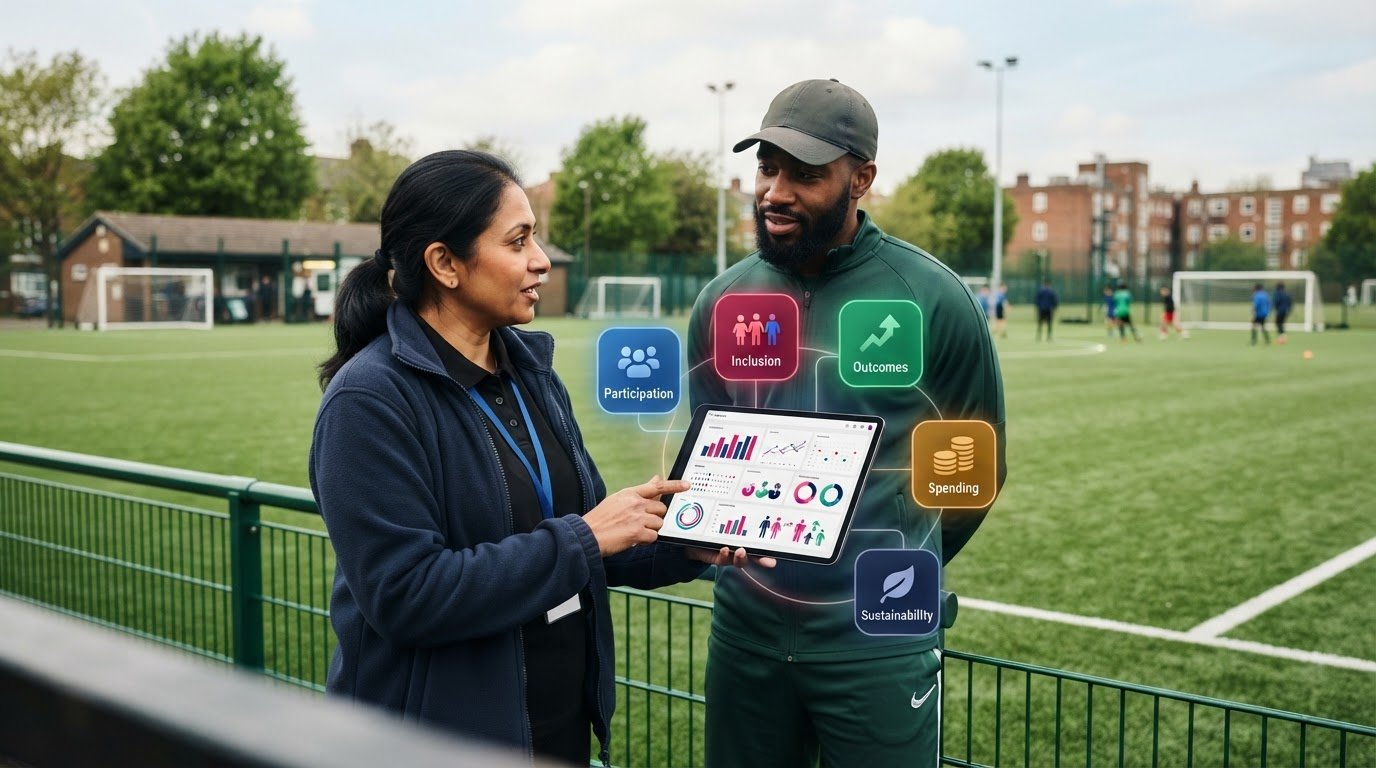
Strong sports funding impact reporting starts with a clear record of what your project aimed to change and what happened. Track participation and outcomes, who took part, community need, spending, income and how you acknowledged the funder.
A grant report needs more than a list of activities. The challenge is collecting useful evidence throughout the project, rather than piecing it together at the end. Consistent records help show how funding was used and whether it reached the people and priorities you intended.
This guide explains what project data to capture about impact, inclusion, spending, community need, income and funder recognition. It also shows how to organise evidence for clear reporting and practical decisions about what to improve next.
Key Takeaways
- Record intended outcomes and participant progress throughout the project so you can show what changed, not just what activities took place.
- Track who takes part and how they relate to the communities your project aims to reach, using consistent categories and counting each person once.
- Connect each grant-funded cost to the activity or outcome it supports, and keep clear records of spending and project income.
- Use evidence of local need to explain why the project matters and how its benefits can continue beyond the funding period.
- Capture funder recognition as you go, including where and how the funding is acknowledged in project communications.
Impact evidence and sustainability planning
Build an evidence trail from the project’s starting point to its outcomes. Connect participation, progress and future plans to the funder’s reporting requirements.
Programme reporting requirements
Programme reporting requirements are the funder’s rules for recording activity, outcomes and spending. They vary across UK sports funding programmes, so follow the criteria and format attached to each award. One funder may prioritise participation data, while another asks for evidence of improved wellbeing or delivery against agreed outcomes. Map each requirement to a record, such as attendance, participant feedback or delivery notes. This keeps evidence relevant and makes the final report easier to prepare.
Start with the award documents, then create a simple list matching each requirement to its evidence. For a school project, separate curricular activity from extra-curricular sessions if the funder requires that distinction. Record the date, activity and intended outcome alongside each piece of evidence. This creates a clear link between funded activity and the result being reported.
Impact report submission frequency
Submission frequency is the timetable a funder sets for progress updates and final reports. There is no single schedule for every UK sports funding programme, so follow the schedule attached to your award. Some programmes request updates during delivery, while others require a report at the project’s end. Sport England emails Movement Fund recipients a reporting form at the end of their project.
Add reporting dates to your project calendar as soon as funding is agreed. Keep attendance and outcome records current instead of rebuilding them before a deadline. For a school programme, capture progress at planned review points, then compare the final results with the starting position. This makes changes easier to explain and supports accurate reporting.
Social return on investment
Social return on investment (SROI) compares the value of social outcomes with the resources used to achieve them. To calculate it, define the outcomes, identify who experiences them, and estimate their value using suitable financial proxies. Then compare that value with project inputs and explain assumptions, evidence and any outcomes that would have happened anyway.
For example, a youth activity project might track participation, connection with others and reported enjoyment. Use consistent baseline and follow-up methods, then explain how each outcome was assessed. Avoid presenting an estimate as a cash saving or a proven causal effect. A transparent calculation is more useful to funders than a headline ratio without an explanation of its method.
Reporting tools and templates
Reporting tools and templates organise project data into evidence for funders. Start with the funder’s own form, then use a spreadsheet or database to track attendance, outcomes, spending and evidence references. Include collection dates and project activities so you can match records to reporting criteria.
Use one shared folder for consented photographs, feedback and delivery records, with clear file names and dates. The Value of Events 2023 report covers the benefits delivered by hosting 16 elite sporting events in the UK, according to UK Sport. Use relevant published reports to inform outcome choices, while keeping project evidence distinct from external examples. For sustainability, record what will continue, who will support it and how it fits the school’s future provision. Schools must use the PE and sport premium to make additional and sustainable improvements to PE, sport and physical activity.
Demographic reach and inclusion
Demographic reach records who participates; inclusion examines whether activities are accessible to the intended groups. Track both to understand who a project serves and where participation gaps remain. An overall attendance figure cannot show whether sessions reach people facing barriers to taking part.
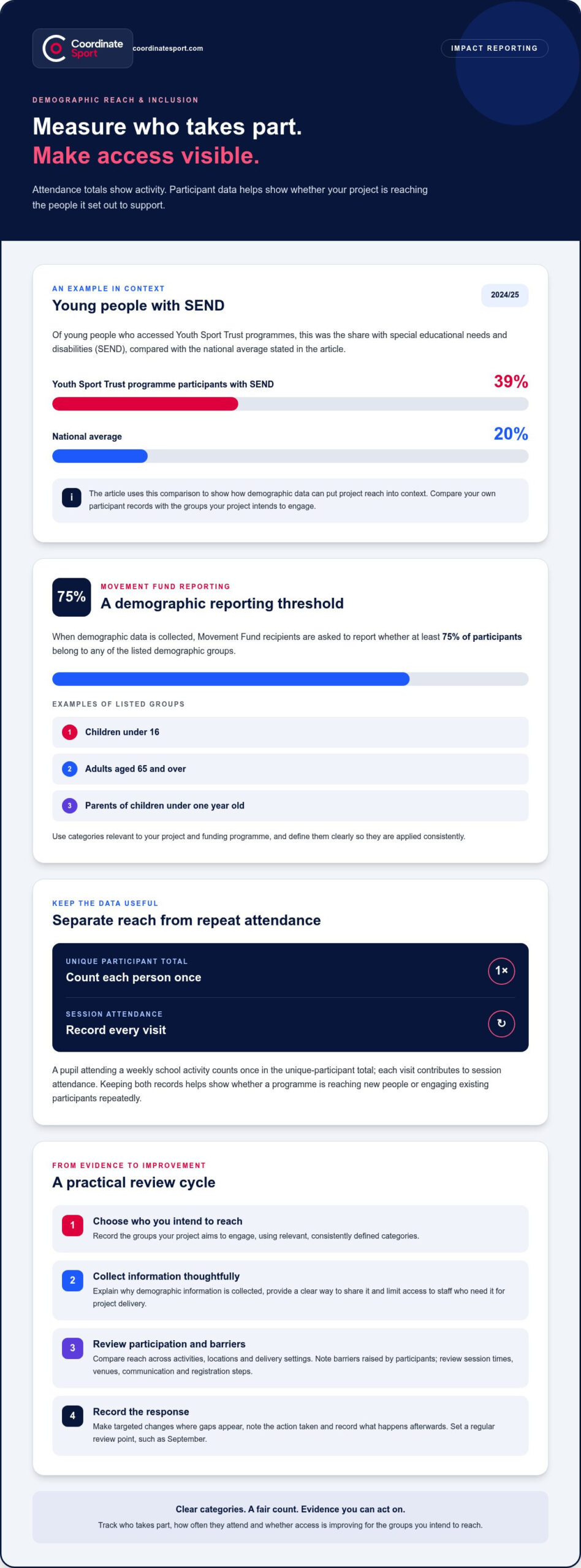
For example, in 2024/25, 39% of young people who accessed Youth Sport Trust programmes had special educational needs and disabilities, compared with a 20% national average. This shows how demographic data can put reach into context. Record the groups your project intends to engage, then compare participant records with that aim. If fewer people from a priority group take part, review session times, venues, communication and registration steps.
Movement Fund recipients are asked to report whether at least 75% of participants belong to any listed demographic groups, when demographic data is collected. Examples include children under 16, adults aged 65 and over, and parents of children under one year old. Use the categories relevant to your project and funding programme. Record how each category is defined, so your team applies it consistently across sessions and settings.
Count each person once, even if they attend repeatedly. Keep a unique participant record and track repeat attendance separately to show both reach and engagement. For example, a pupil attending a weekly school activity counts once in the unique-participant total, while each visit contributes to session attendance. This distinction shows funders whether a programme is reaching new people or deepening engagement with existing participants.
Make data collection practical. Explain why you gather demographic information, provide a clear way to share it and limit access to staff who need it for project delivery. Compare participation across activities, locations and delivery settings. For example, a school sport premium project can assess whether activities reach the pupils it aims to support, rather than relying on an overall school total. Use the findings to make targeted changes and record what happens afterwards.
Set a regular review point, such as September, and compare current reach with the project’s intended groups. Note any access barriers raised by participants and the action taken, such as changing a venue or revising session communications. These records connect inclusion aims with delivery decisions and give funders a clear account of progress. For consistent participant records across sessions, sports CRM and booking software can support registration and participant management.
Grant spending categories
Grant spending categories group project costs by purpose, making it easier to evaluate budget use and outcomes. For each cost, record the amount, date, budget line, activity supported and relevant evidence. Compare planned allocations with actual spending, and explain any changes in relation to the project’s aims.
In England, sports funding for schools can only be spent on sport and PE provision. Budget categories can still vary by project. These examples show how to record facility spending separately from delivery costs.
Separate equipment and facility costs from activities, services and enrichment. Clear categories help readers see what the funding supported, rather than just the total expenditure.
Show how each allocation relates to the activity delivered. Keep the relevant invoice and connect each payment to delivery records, such as session schedules or attendance. This creates a clear financial trail from the budget decision to project activity.
Track allocations by outcome as well as cost type when the funder’s reporting framework requires it. Keep indicator labels alongside the amounts so their meaning is clear.
For every transaction, retain the original document and note why the cost was necessary. Movement Fund recipients should keep original receipts, invoices and bank statements for all project spending. Reconcile these records with the project budget, then explain any differences in plain language. If a planned activity changes, record the revised spending and the reason for the decision.
Pair financial records with evidence of delivery. If spending supports a school activity, match the cost to the sessions delivered and the intended participant benefit. Parents’ feedback can add context to an enrichment day, while attendance records show participation. Present actual spending alongside outcomes, distinguishing completed work from future plans. This helps funders assess whether resources supported the agreed project purpose.
Impact in areas of greatest need
Evidence of impact in areas of greatest need shows how a project responds to community priorities and barriers. Start with a clear statement of need: identify the community, explain the challenge and connect the planned activity to a specific change. For example, a school might document pupils’ limited access to organised activity after lessons, then track participation and feedback from its after-school sessions.
Build the case on local information, not assumptions about a whole community. Review existing attendance patterns, pupil feedback, access barriers and available facilities. Separate what you observe from what you plan to address. A children’s activity project might find that travel prevents families from attending a central venue, then test a more accessible setting and record whether participation changes.
Use an outcome that reflects the identified need. If children report low enjoyment, collect a simple baseline and repeat the same question during delivery. In 2024/25, 75% of young people who engaged with Youth Sport Trust programmes felt improved happiness. This provides an example of an outcome measure; it does not replace evidence from your own participants or establish that every project will produce the same result.
Connect the activity to an appropriate progress measure. The Chief Medical Officer guidelines recommend that children and young people aged 5 to 18 undertake at least 60 minutes of physical activity per day, including 30 minutes at school. A school addressing limited movement opportunities could record the activity it provides, participation and pupil feedback. Keep the project’s contribution distinct from children’s total daily activity.
Show who benefits and what changes for them. During 2024/25, 74% of practitioners reported positive impacts of Youth Sport Trust programmes on young people’s engagement with school. A project with a similar aim could collect practitioner observations alongside attendance and pupil feedback. Define the observation method in advance, so progress can be compared consistently across delivery periods.
Use evidence to refine delivery, not just describe need. If few pupils attend a particular session, review its timing, location and format, then record the adjustment and the response. For example, a school could compare participation before and after changing an activity time. Keep a brief record of the decision, the evidence behind it and the observed outcome.
Finish with a statement that links community need, delivery and learning. Name the priority, describe the activity designed to address it, and report the outcome using project evidence. If results differ between groups or settings, explain that pattern and the next action. This gives funders a practical account of how resources respond to need and how future delivery will develop.
Income reporting and funder recognition
Clear income records show where project resources came from and how they supported delivery. Pair financial reporting with accurate, visible recognition of each funder’s contribution.
Reporting income
Income reporting records funding and other resources received for a project. List each grant separately, then record other project income, such as participant contributions or partner support, where applicable. Note the amount received, date, source and intended purpose, using the award letter and financial records as evidence.
Keep income separate from spending. For example, record a targeted coaching grant separately from payments for delivering those sessions. If a partner provides venue access or equipment rather than money, describe that support clearly instead of including it as cash income. This gives funders a useful picture of the project’s resources and contributions.
Reconcile the income record with your project budget and account statements before reporting. Sport England emails Movement Fund recipients a reporting form at the end of their project. Prepare the relevant income details alongside delivery and spending records so the final submission gives a consistent account of project activity.
Risks of inaccurate or incomplete reports
Inaccurate or incomplete reports give funders an unreliable account of how project resources were used and what they achieved. They can also create gaps between reported income, spending and delivery evidence. For example, omitting a partner contribution can leave the resource picture incomplete, while reporting the wrong grant amount can undermine confidence in the report.
What are the risks of inaccurate or incomplete sports funding reports? They can make it harder for a funder to assess delivery, outcomes and use of funds, and may prompt follow-up questions or delay review. Match each reported figure to a record, and clearly label estimates or non-cash support.
Review the report before submission. Compare the award amount, income received, project expenditure and remaining balance, then resolve inconsistencies using original records. Check that the reporting period and project name match the funder’s form. For a school, align the grant-spending and declaration documents with the relevant sports premium report.
Funder recognition means accurately acknowledging support in project communications and materials. Keep dated examples, such as a programme notice or event display, and record where the recognition appeared. Obtain informed consent from participants shown in photographs or videos before sharing those materials with the funder.
Build recognition into delivery rather than adding it after the final session. Assign responsibility for acknowledging the funding in relevant updates, event materials and partnership communications. Keep copies with the project records, then include a concise summary in the final report. Explore reporting and data for funders to organise project information for clear reporting.
Coordinate Sport: Sports CRM and booking software
Coordinate Sport Ltd provides sports CRM and booking software to help sports organisations manage activity administration in one place. Online booking and registration for sessions, courses, clubs, camps, holiday activity programmes and events create structured participant and attendance records to support project monitoring.
Use the platform when registrations, participant details and activity administration are spread across separate processes. The Activity Management Application and Sports Activity Provider Staffing Application help coordinate delivery, while organised records help teams prepare information for funders and management.
Use these tools alongside your own outcome measures, spending records and funder requirements. They support operational data management, while your project team remains responsible for interpreting evidence and completing reports. Contact Coordinate Sport Ltd to discuss how its platform can support your activity administration.
Make your next reporting cycle work harder
Use sports funding impact reporting as a management tool, not just a final submission. Decide how your team will use the evidence after reporting, whether to refine delivery, plan future activity or shape a funding proposal. A brief review meeting can turn findings into clear actions, with an owner assigned to each next step.
Good decisions also depend on reliable operational records. Coordinate Sport offers sports CRM and booking software, a Sports Activity Provider Staffing Application and an Activity Management Application. These tools support the administration of sports activity, while your team interprets the evidence and prepares its funder report.
If you’re ready to strengthen the way your organisation manages project information, contact Coordinate Sport to discuss your reporting. Take the next step with a clearer process and keep building on what your evidence tells you.
Frequently Asked Questions
What data do I need to collect throughout my project?
Collect records that connect delivery with your project’s intended outcomes. Alongside registrations and attendance, note the activity date, session type, delivery setting and any changes made during the project. Gather feedback using the same questions at planned review points so responses can be compared. Record the source of each figure and who updated it to make later checks and report preparation easier.
What is sports funding impact reporting?
Sports funding impact reporting shows how a funded project used its resources and what difference its activities made. It combines delivery records with evidence of outcomes, helping funders assess progress against the purpose of their award. For example, a project can connect a funded activity with participant feedback and a delivery record, then explain how that evidence supports its conclusions.
What impact measures do UK sports funders require?
No single measure applies to every UK sports funding programme. The right measures depend on the award’s aims and reporting instructions. A project focused on access might report participation by intended group; one targeting school engagement could collect practitioner observations alongside participant responses. Before delivery begins, turn each stated outcome into a measure, a collection method and a named person responsible for recording it.
How should sports organisations measure participation and inclusion outcomes?
Choose measures that show who took part and how their experience developed. Record registrations and attendance separately, and use consistent participant categories across activities. Offer feedback methods suited to the group, such as a short verbal check-in for younger children or a written response for older participants. Review results by activity and setting to identify differences, and document any delivery changes made in response.
What data and evidence should a sports funding impact report include?
Include a clear account of project delivery, outcomes, income, spending and funder recognition, supported by traceable records. Add the reporting period, explain how measures were collected, and distinguish direct observations from participant feedback. Obtain informed consent from participants shown in photographs or videos shared with a funder. A concise evidence index can help reviewers find supporting documents without searching unrelated files.